

Imagine a crisp autumn morning in the Hudson Valley. Instead of navigating the narrow, white-knuckled shoulders of Route 9D or searching for an elusive parking spot near a crowded trailhead, you step off a Metro-North train and onto a wide, sweeping boardwalk that hovers just above the water’s edge. To your left, the majestic Hudson River ripples against the shore; to your right, the dramatic granite face of Breakneck Ridge rises toward the sky. This is the promise of the Hudson Highlands Fjord Trail (HHFT).
The HHFT is a world-class, 7.5-mile linear park currently coming to life between the Village of Cold Spring and the City of Beacon. As we move through early 2026, this decades-long vision is no longer just a set of beautiful renderings; it is a project in active motion, reshaping how we interact with one of the most iconic landscapes in America.
A Safety Solution Born of Necessity
For years, the stretch of Route 9D between Cold Spring and Beacon has been a point of high tension. As the popularity of the Hudson Highlands exploded—with Breakneck Ridge often cited as one of the most popular day-hikes in the country—the infrastructure simply couldn’t keep up. Thousands of hikers were forced to walk along a high-speed highway shoulder, and cars spilled out of small lots into dangerous roadside queues.
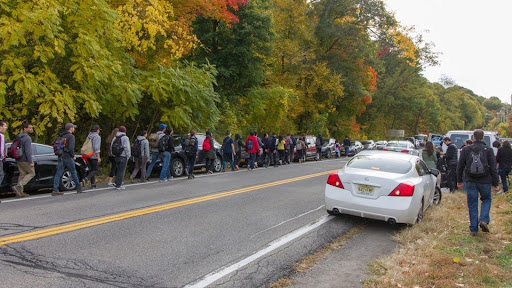
The Fjord Trail was born from a grassroots community desire to solve this “safety vs. beauty” paradox. Organized by Hudson Highlands Fjord Trail, Inc. (a subsidiary of Scenic Hudson) in partnership with NYS Parks, the project’s primary mission is to “choreograph” the visitor experience. By creating a dedicated, off-road path, the project aims to take pedestrians off the highway, manage the flow of tourists away from over-burdened residential streets, and provide modern amenities like restrooms and trash collection that the Highlands have long lacked.
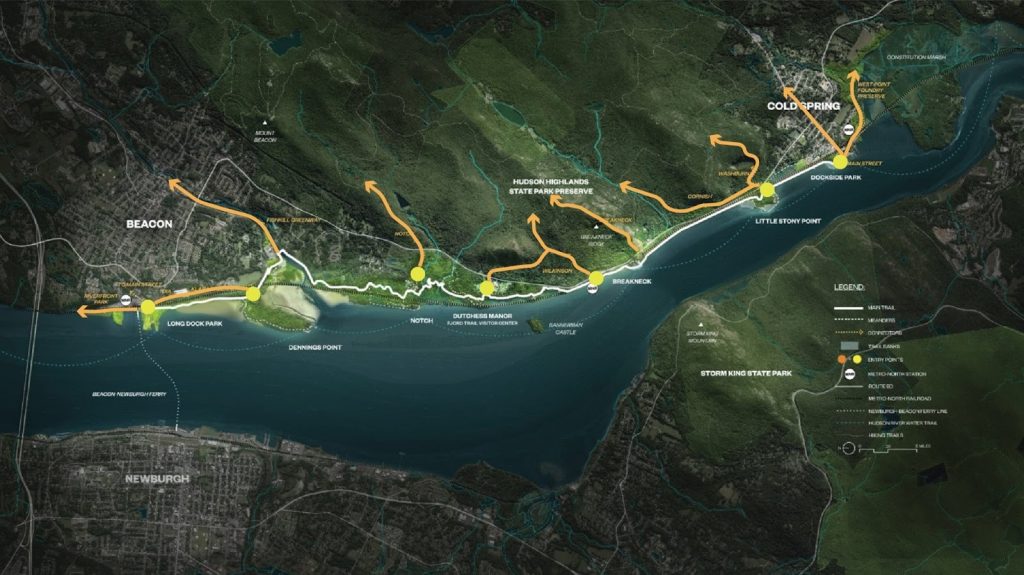
The Fjord Trail is a bold experiment in “sustainable tourism.” Rather than trying to stop people from visiting—an impossible task in a digital age—the project aims to manage them. By providing six distinct entry points (including Beacon, Cold Spring, and Dutchess Manor), the trail will distribute crowds more evenly across the 7.5-mile span. This “de-densification” is designed to relieve the “bottleneck” effect currently felt on Cold Spring’s Main Street.
A Masterpiece of Landscape Architecture
The Fjord Trail is a sophisticated piece of landscape architecture designed by the world-renowned firm SCAPE, meant to feel like a natural extension of the river’s ecology. Along its 7.5 mile, the different sections of the trail will each offer a distinct way to experience the Highlands:
1. The Shoreline Trail
Perhaps the most anticipated element, this section will feature a series of elevated boardwalks and paths that bring visitors directly to the river’s edge. For over a century, the Metro-North tracks have acted as a barrier between the community and the water. The Shoreline Trail reclaims this space, offering “meanders” where you can sit and watch the tide or launch a kayak.
2. The Breakneck Connector & Bridge
As the gateway to the trail’s most rugged terrain, the Breakneck Connector is a feat of engineering. A new, elegantly arched pedestrian bridge of weathering steel will span the railroad tracks, connecting the waterfront to the mountain. This zone also includes a completely reimagined Metro-North Breakneck Ridge station, featuring 40-foot platforms and safety lighting to make transit the easiest way to arrive. Based on the urgent need to resolve the existing parking, safety, and erosion concerns, construction is already underway on the .7-mile Breakneck Connector and Bridge as the first phase of the Fjord Trail project to be undertaken.
3. The Forest and Highlands
Moving north toward Beacon, the trail climbs into the “canopy.” Here, the experience shifts to an immersive woodland walk. Elevated sections will allow visitors to move through the trees without disturbing the sensitive forest floor, providing views of the river through a frame of ancient oaks and hemlocks.
4. The Visitor Center at Dutchess Manor
At the midpoint of the trail sits Dutchess Manor, a 19th-century landmark being painstakingly restored to serve as the project’s operational hub. This will be the trail’s “front door,” providing significant parking, a shuttle hub, public programming, and—most importantly—a place for visitors to learn about the history and ecology of the land before they set out.
The View from 2026: Recent Updates
If you’ve driven past Breakneck Ridge lately, you’ve seen the transformation in real-time. We are currently in a period of intense and exciting progress.
The SEQR Milestone
In January 2026, the project cleared its most significant hurdle to date: the completion of the State Environmental Quality Review (SEQR) process. After years of study, public hearings, and thousands of pages of environmental impact statements, the New York State Office of Parks, Recreation, and Historic Preservation officially issued its “Findings Statement.” This document confirms that the project’s benefits—including safety, accessibility, and restoration—outweigh its impacts, and it provides a legally binding roadmap for how the trail must be managed to protect the environment.
Construction Progress
Ground was officially broken on Phase 1 (The Breakneck Connector) in July 2025. Currently, The Breakneck Ridge Trailhead and Train Station remain closed (and are expected to stay closed until early 2027) to allow for the massive structural work on the pedestrian bridge and station platforms. Check out www.breakneck.info for information on project updates and alternative trails to explore during the closure.
Construction of Fjord Trail North will begin this year, encompassing the area north of Breakneck Ridge in Fishkill to Long Dock Park in Beacon.
Recognizing the importance of local collaboration and the shared goal of improving the existing pedestrian conditions along Fair Street in Cold Spring, HHFT has also announced its commitment of a $450,000 grant to the Village of Cold Spring and Town of Philipstown as matching funds for the municipalities’ application for a NYS Department of Transportation (DOT) grant.
Looking Ahead: Accessibility for All
Perhaps the most heartening fact about the Hudson Highlands Fjord Trail is who it is for. For too long, the best views of the Highlands were reserved for those capable of a vertical rock scramble.
When the “Main Trail” opens (projected for the early 2030s), it will be a 10-to-14-foot wide, ADA-accessible path. This means a grandparent can walk with their grandchild at the river’s edge; a veteran in a wheelchair can experience the majesty of the “Notch”; and a family from the city can take the train and spend a day in nature without ever needing a car. The Hudson Highlands Fjord Trail is more than a construction project—it is an investment in our collective mental health, our regional ecology, and our future as a state that welcomes the world to its doorstep with open arms and a sustainable plan.