

How a bold 1890s experiment led to one of the nation’s most extensive greenway networks–and what it can teach us today.
Contributed by: Erica Schneider
If you’ve ever pedaled along the Empire State Trail or one of New York’s many spectacular greenways, you’re part of a movement that has deeper roots than many people realize. Long before modern greenways, long before rail-trail conversions, and decades before the automobile took over American roads, New York State built one of the most ambitious bicycle infrastructure networks in the world.
Yes, New York had a 2,000-mile bicycle highway system by the year 1900.
This extraordinary network, known as the sidepath system, was the result of passionate cyclists, forward-thinking engineers, and everyday New Yorkers who believed that safe, connected bicycle travel was a public good. And although the system ultimately faded with the rise of the automobile, its legacy offers powerful lessons for today’s trail planners, advocates, and communities.
This history shows that greenways are not new, but rather a revival of something New Yorkers once valued deeply. And as we grow our statewide trail network, the sidepath movement of the 1890s reminds us just how visionary, feasible, and transformative this work can be.
Before Bike Lanes, Before Rail-Trails—There Were High-Wheel Adventurers
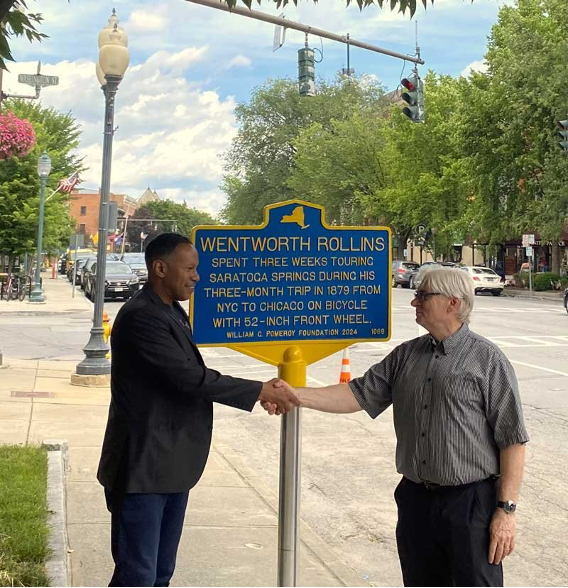
Pomeroy sign installed in Saratoga Springs in 2024 to commemorate Wentworth Rollin’s epic ride.
Our story begins with the daring cyclists of the 1870s and 1880s—men riding precarious high-wheel bicycles (the famous “penny-farthings”), pedaling across rutted wagon roads and canal towpaths simply because no better options existed.
One of them, Wentworth Rollins, became a national celebrity in 1879 when he attempted to bike from New York City to Saratoga Springs. Newspapers breathlessly followed his journey as he slogged through deep ruts, pushed through mud, swerved around startled horses, and even hopped on trains when the roads failed him altogether.
These early cyclists weren’t just thrill-seekers. They were the first to document the glaring need for smoother, safer, more continuous routes for human-powered travel. Their stories—part travelogue, part infrastructure audit, helped spark the broader Good Roads movement.
And then came a technological revolution.
The Safety Bicycle Changes Everything
In 1886, the first “safety bicycle” appeared: two equal-sized wheels, a chain drive, and soon after air-filled tires. It was safer, lighter, easier to ride, and, thanks to early mass production, increasingly affordable. Suddenly, cycling belonged to everyone.
Women, workers, teenagers and Sunday riders all found new freedom on the wheel. Cycling clubs multiplied. Bicycle touring became a national phenomenon. And New Yorkers wanted more than bumpy dirt roads. They wanted infrastructure worthy of this new, liberating machine.
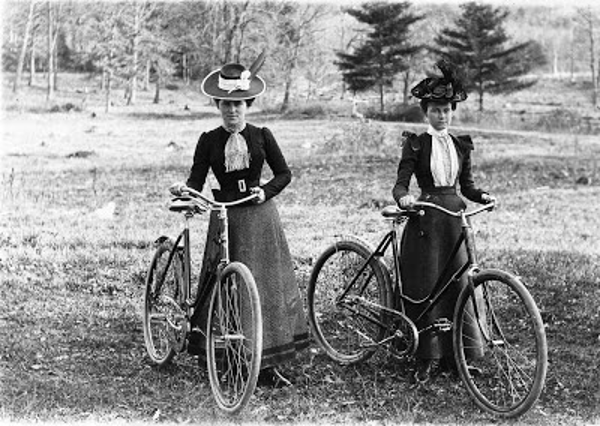
Two women stopped during a bicycle ride around 1900 in Schenectady. / photo: Larry Hart Collection, Schenectady County Historical Society, Grems-Doolittle Library
The Sidepath Movement: New York’s Bold Experiment
Enter Charles T. Raymond, an RPI-trained engineer and founding member of the Lockport Wheelmen, with a radical yet pragmatic idea: instead of waiting for expensive, politically contentious road reform, what if cyclists built their own dedicated paths alongside existing roads?
Raymond believed that bicycle sidepaths could actually help make the case for road improvements by showcasing what was possible when engineering principles were applied. He envisioned sidepaths as elevated, well-drained, scientifically constructed routes that could be built quickly and at relatively low cost.
That vision became reality in 1892, when Niagara County cyclists raised private funds to construct one of the nation’s first purpose-built bicycle facilities: a 12-mile crushed-stone sidepath from Lockport to Olcott Beach on Lake Ontario. Far from a simple dirt track, the path incorporated thoughtful engineering, with graded surfaces for smooth riding, drainage ditches and culverts to manage water runoff, and carefully tested surfacing materials that proved durable under repeated use. The success of this initial corridor demonstrated that high-quality bicycle infrastructure was both technically feasible and publicly popular.
Recognizing that volunteer labor and private donations alone could not sustain expansion, Raymond took an unprecedented step: he drafted legislation. In 1896, New York State passed a law authorizing Niagara County to create a Sidepath Commission to raise funds by taxing bicycles to keep building out the network.
Other counties took note, and momentum accelerated with the statewide enabling legislation in 1899, signed by Governor Theodore Roosevelt, which created the first statewide framework for dedicated bicycle infrastructure in the United States.
Any county with a petition from fifty local cyclists could establish a sidepath commission, sell annual sidepath licenses (typically costing 50 cents to one dollar), and begin construction along public highways. Within weeks of passage, dozens of counties formed commissions and began building. Commissioners, appointed locally and serving without pay, were granted authority to design paths, set rules of use, levy fines, acquire rights-of-way, and coordinate with highway officials.
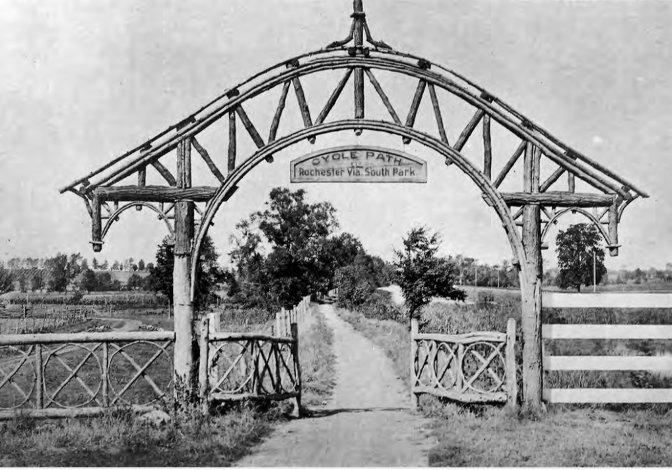
Photograph of the Scottsville Cycle Path by Cline Rogers from the album Sidepaths: Monroe County (1899). From Robert L. McCullough. (2015). Old Wheelways : Traces of Bicycle History on the Land. The MIT Press.
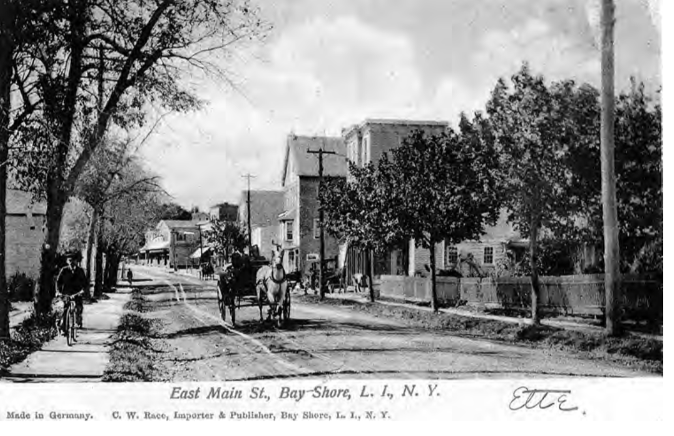
Postcard showing the Bayshore Sidepath (on far left) on Long Island. From Robert L. McCullough. (2015). Old Wheelways : Traces of Bicycle History on the Land. The MIT Press.
The results were astonishing. Sidepaths multiplied county by county, growing from short recreational segments into connected regional corridors. Cyclists paid small annual fees for sidepath licenses, creating a dedicated, if ultimately fragile, funding stream. Engineering standards spread rapidly, construction costs dropped through economies of scale, and counties competed enthusiastically to report new mileage at annual conventions.
By 1901, New York State boasted more than 2,000 miles of sidepaths, the most extensive bicycle path network in the nation. Riders could travel from village streets to rural highways, from industrial towns to scenic destinations, and, remarkably, from Brooklyn all the way to Niagara Falls on nearly continuous bicycle infrastructure (looks like the concept for the Empire State Trail wasn’t so new after all!). For a brief moment at the turn of the twentieth century, New York offered a nearly fully realized vision of statewide, human-powered mobility, decades before automobiles would come to dominate the road.
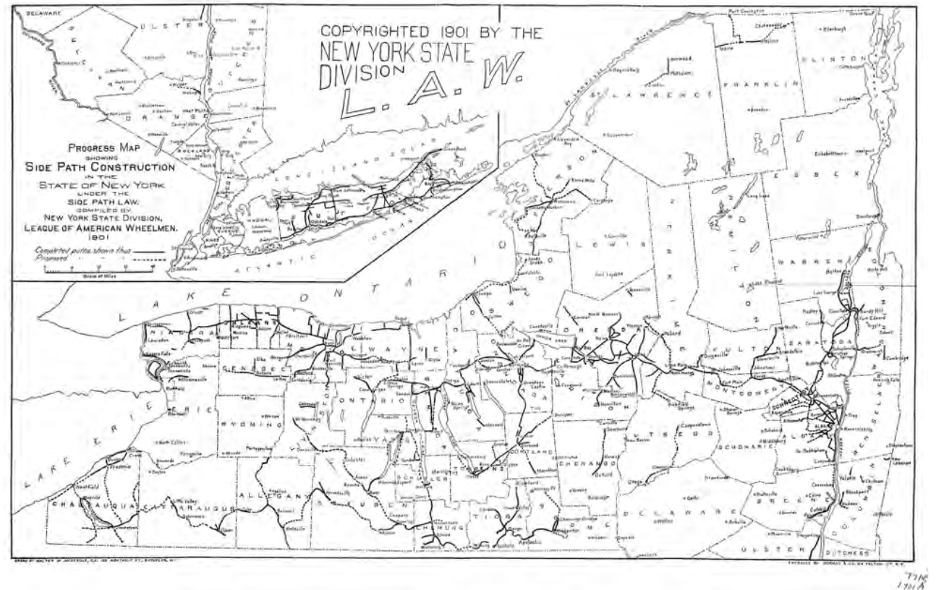
Progress Map Showing Side Path Construction in the State of New York (1901). From Robert L. McCullough. (2015). Old Wheelways : Traces of Bicycle History on the Land. The MIT Press.
So What Happened?
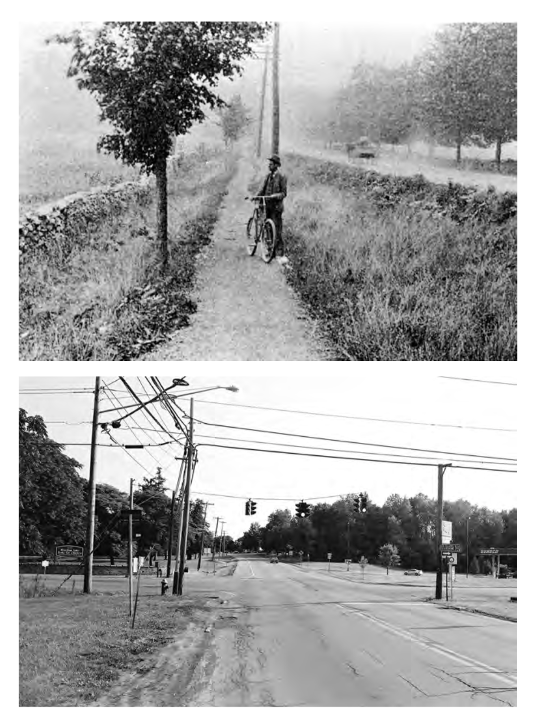
Image of the original Lockport sidepath contrasted with an image of the same scene in the 2000’s. From Robert L. McCullough. (2015). Old Wheelways : Traces of Bicycle History on the Land. The MIT Press.
Despite its visionary design, the sidepath network was vulnerable.
- Funding relied almost entirely on bicycle license fees
- Maintenance needs grew faster than revenue as the network expanded
- The automobile began its meteoric rise
- Political support shifted, and counties struggled to sustain their networks
By the 1920s, most sidepaths had been swallowed by widening roads, repurposed by railroads, or overtaken by vegetation. A few faint traces remain in today’s landscapes—but most New Yorkers have never heard of them.
Why This History Matters Now
Today, New York is once again leading the nation with long-distance trails like the Empire State Trail, and communities statewide are investing in greenways for recreation, transportation, economic development, and climate resilience.
The sidepath movement offers timely lessons:
1. Quick-build infrastructure works.
Cyclists in the 1890s didn’t want to wait decades for safer, smoother roads. Sidepaths delivered immediate, visible improvements. Today’s quick-build traffic calming projects and cycle tracks follow the same philosophy.
2. Maintenance isn’t optional, it’s the backbone of a network.
Sidepaths failed not because they weren’t loved, but because they weren’t sustainably maintained. Modern greenways need dedicated, long-term funding strategies to avoid the same outcome of chasing the next ribbon cutting without allocating funds for maintenance.
3. Statewide coordination is essential.
The sidepath system grew county by county without a strong statewide support structure. Modern trail networks thrive when state agencies align—something PTNY continues to advocate for.
4. The desire to explore New York at a human scale never went away.
Cyclists in the late 1800’s sought the same things trail users seek today: freedom, exploration, scenic beauty, and meaningful connection to the landscape.
5. Roads were not always built exclusively for cars, and they don’t have to be today.
One of the most powerful lessons of the sidepath movement is that automobile dominance was never an inevitable outcome of history. In the late 19th century, New York’s roadways were contested, flexible spaces, used by pedestrians, cyclists, wagons, and streetcars, and the state explicitly set aside space for bicycles through law, design, and public investment.
Sidepaths were not afterthoughts; they were deliberately planned, legislated, and engineered as essential transportation infrastructure. Their later disappearance was not the result of failure, but of political choices that prioritized automobiles over all other users.
Recognizing this history matters today because it reframes modern bike lanes, greenways, and protected paths not as radical experiments, but as acts of reclamation. When communities reallocate roadway space for bicycles and pedestrians, they are not inventing something new—they are reviving a legacy New York once led, and choosing once again to dedicate public space to safe, human-scaled mobility.
At Parks & Trails New York, we see the sidepath movement not as a bygone curiosity but as a powerful reminder of what New Yorkers can accomplish when we believe in human-powered mobility.
More than 120 years later, we’re still writing the next chapter of this statewide trail legacy–one mile, one community, one connection at a time.
Sources:
Longhurst, J. (2015). Bike battles. University of Washington Press. https://research-ebsco-com.libproxy.albany.edu/plink/39fa7fbf-81f7-3657-80a6-3b66c59ee442
McCullough, R. L. (2015). Old wheelways: Traces of bicycle history on the land. MIT Press. https://research-ebsco-com.libproxy.albany.edu/plink/cfca5e3d-092d-356b-9e6d-713ee8fb3dd4
Potter, I. (1892). The gospel of good roads. Good Roads: An Illustrated Monthly Magazine Devoted to the Improvement of Public Roads and Streets, 1. https://babel.hathitrust.org/cgi/pt?id=uiug.30112056670133&seq=11
“On a Bicycle to Saratoga,” New York Times, July 4, 1879, p. 8